
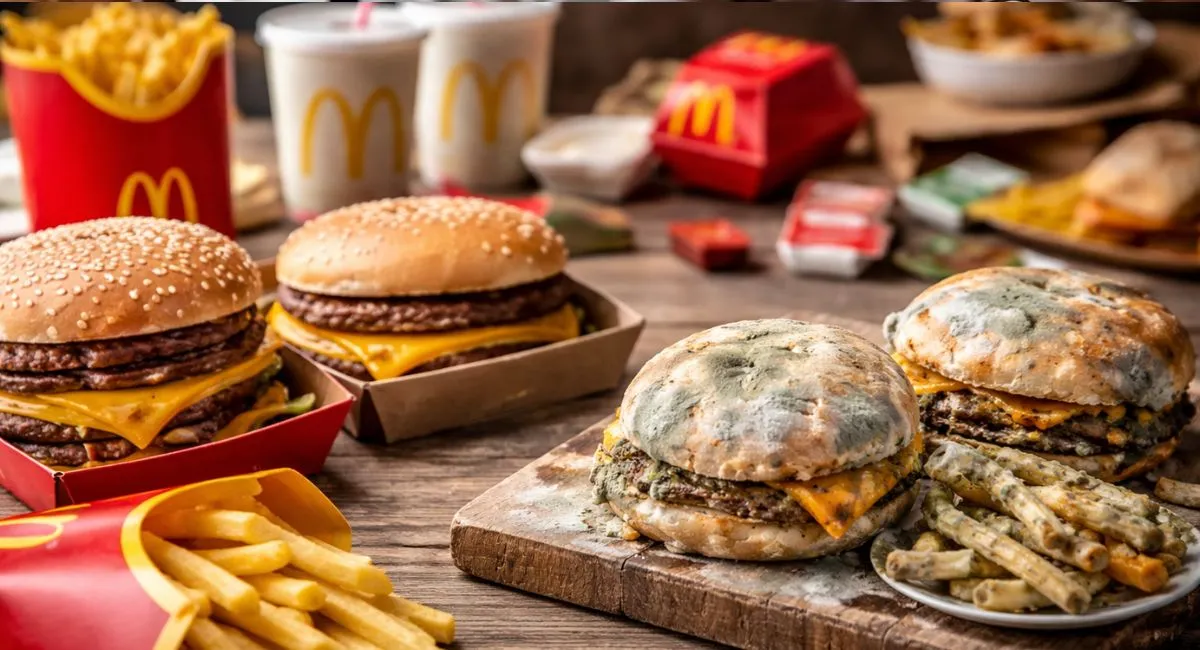
The idea of McDonald’s food not rotting has fueled countless debates and conspiracy theories over the years.
Viral stories and experiments—like a decades-old burger appearing unchanged—have raised questions about food quality and ingredients.
However, the reality behind McDonald’s food not rotting is far less mysterious and much more scientific.
Let’s break down the facts, debunk myths, and understand what’s really happening.
The Origin of the “McDonald’s Food Not Rotting” Myth
One of the most famous examples comes from David Whipple, who revealed a hamburger he had kept since 1999. After more than 20 years, the burger looked almost identical to when it was purchased, except for a decomposed pickle.
Stories like this have strengthened the belief that McDonald’s food not rotting must be due to artificial preservatives or chemicals. Many assume that such long-lasting food must be heavily processed or unnatural.
However, this assumption overlooks basic food science.
What McDonald’s Says About the Claim
McDonald’s has publicly addressed the topic, stating that McDonald’s food not rotting is largely a myth when viewed in the right context.
According to the company:
- Their burger patties contain no added preservatives or fillers
- The only seasoning used is salt and pepper
- Under certain environmental conditions, their food can and does decompose
So why do some burgers appear unchanged?
The Real Science Behind McDonald’s Food Not Rotting
1. Dehydration: The Key Factor
The primary explanation for McDonald’s food not rotting is moisture loss.
When burgers are cooked at high temperatures:
- Most of the water content evaporates quickly
- The patty becomes dry soon after cooking
If the burger is left in a low-humidity environment, it continues to lose moisture instead of staying damp.
Without moisture:
- Bacteria and mold struggle to grow
- The food doesn’t rot—it simply dries out
This process is similar to mummification, not preservation through chemicals.
2. Similarity to Dried Foods Like Jerky
To better understand McDonald’s food not rotting, compare it to:
- Beef jerky
- Biltong
These foods are intentionally dehydrated to prevent spoilage. The lack of water inhibits microbial growth, allowing them to last for extended periods.
A McDonald’s burger left out under the right conditions undergoes a similar natural drying process.
3. The Role of Salt
Salt, even in small amounts, contributes to the phenomenon of McDonald’s food not rotting.
- Salt helps draw out moisture
- It slows down bacterial growth
Although McDonald’s uses minimal seasoning, even that slight presence of salt can assist in drying the patty faster.
Storage Conditions Make a Huge Difference
Another critical factor in McDonald’s food not rotting is how the food is stored.
For example:
- David Whipple kept his burger in a sealed container
- It was protected from humidity, air, and light
In such conditions:
- Mold spores have limited access
- Moisture cannot re-enter the food
- The burger remains dry and stable
If the same burger were left in a humid environment, it would likely:
- Develop mold
- Break down naturally
- Rot like any other food
Why It Looks “Unchanged”?
The reason McDonald’s food not rotting appears so unusual is visual perception.
Even though:
- The burger has lost moisture
- Its texture has hardened
It may still:
- Retain its shape
- Look structurally intact
This gives the illusion that nothing has changed, when in reality, the internal composition is completely different.
Debunking Common Misconceptions
Myth 1: McDonald’s Uses Heavy Preservatives
There is no strong evidence supporting this claim for their burger patties. The explanation for McDonald’s food not rotting lies in dehydration, not chemicals.
Myth 2: Fast Food Is Indestructible
All food will eventually break down under the right conditions. The case of McDonald’s food not rotting is simply about environmental factors, not immunity to decay.
Myth 3: It’s Unsafe to Eat
A dried-out burger may not rot, but it’s definitely not safe or appealing to eat after long exposure.
The Role of Environment in Food Decomposition
Food spoilage depends on several factors:
- Moisture
- Temperature
- Oxygen
- Microbial presence
When these elements are limited, as in cases of McDonald’s food not rotting, decomposition slows dramatically.
This is why:
- Refrigeration slows spoilage
- Freezing halts bacterial activity
- Drying preserves food
Why This Matters for Consumers?
Understanding McDonald’s food not rotting helps separate fact from fiction.
Instead of assuming:
- Artificial additives are responsible
It’s more accurate to recognize:
- Natural preservation processes like dehydration
This knowledge can also help you:
- Store food better
- Reduce waste
- Understand how food behaves over time
The mystery of McDonald’s food not rotting is not as alarming as it first appears. Rather than being packed with chemicals or unnatural ingredients, the explanation lies in simple science—moisture loss and environmental conditions.
When a burger dries out quickly, it prevents bacteria and mold from growing, effectively stopping the typical rotting process. This is the same principle behind dried foods like jerky.
Ultimately, McDonald’s food not rotting is a case of misunderstanding natural preservation, not evidence of something unnatural. Knowing this helps clear up myths and provides a more informed perspective on fast food.
FAQs
Why does McDonald’s food not rot quickly?
Because it loses moisture rapidly, preventing bacteria and mold from growing, which are essential for decomposition.
Does McDonald’s use preservatives in their burgers?
According to the company, their patties contain no added preservatives—only salt and pepper are used.
3. Can other foods also not rot like this?
Yes, any food that dries out quickly in low humidity conditions can resist rotting, similar to jerky or dried meats.